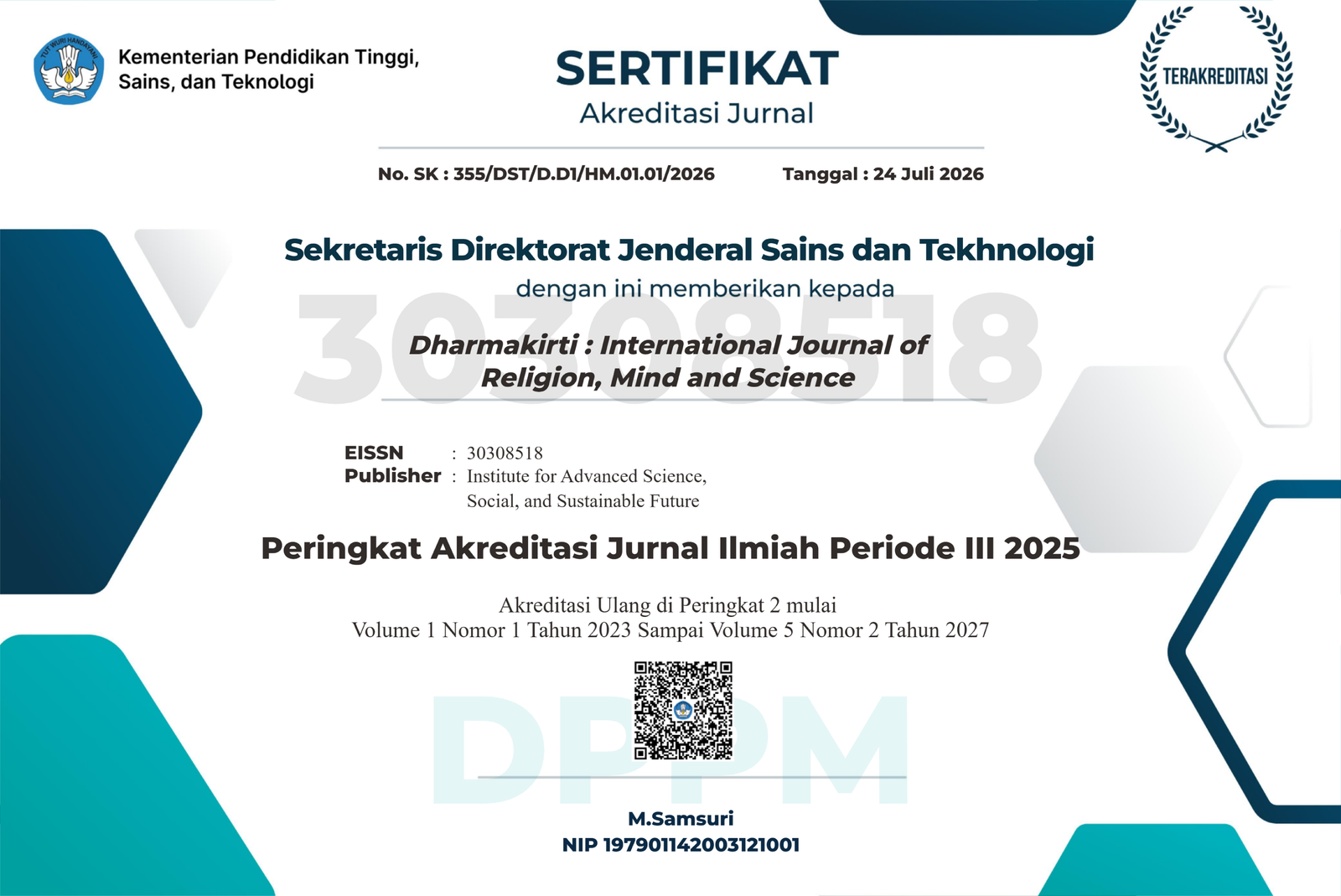
Danu Kerthi as a Hindu theo-ecological practice in conservation of water resources
DOI:
https://doi.org/10.61511/ijroms.v4i1.2026.4038Keywords:
Danu Kerthi, focused ethnography, Hindu theo-ecology, Lake Batur, sacred water, water resource protectionAbstract
Background: This study examines Danu Kerthi as a Hindu theo-ecological practice for water resource protection at Lake Batur, Bali. It employed a qualitative approach using a focused ethnographic design conducted from January to March 2026, covering the periods before, during, and after Tumpek Uye. Methods: Data were collected through participant observation, in-depth interviews with 30 informants consisting of customary leaders and community members involved in the tradition, informal conversations, documentation, and a review of scientific publications and policy documents. The data were thematically analyzed across theological, ethical-ecological, and practical dimensions. Findings: The findings demonstrate that Danu Kerthi has been practiced for generations, long before the enactment of Bali Governor Regulation No. 24 of 2020. The tradition shapes the identity of the Batur community as guardians of the lake and centres on the worship of Dewi Danu, locally experienced as Bhatari Batur. The local cosmology reveals a strong feminine dimension in which water is understood both as the source of life and as a manifestation of divine presence. Nevertheless, the study identifies a theo-ecological paradox between the symbolic sacredness of the lake and its material condition. Floating and submerged waste, declining water clarity, odour, nutrient pollution, pressure from floating net cages, agricultural runoff, domestic wastewater, recurrent fish mortality, and invasive species indicate that Lake Batur remains productive but is ecologically degraded and increasingly vulnerable. Conclusion: The study concludes that Danu Kerthi can function as a comprehensive theo-ecological practice only when its niskala dimension is translated into sakala actions, including pollution control, use restrictions based on ecological carrying capacity, stronger customary regulations, regular water-quality monitoring, and ecosystem restoration. Novelty/Originality of this article: Thus, the sacredness of water should not only be ritually affirmed but also demonstrated through the ecological integrity and long-term sustainability of Lake Batur.
References
Apriyanto, H., Warseno, W., Mukti, S. H., Suhendra, A., Tamtomo, T. D., Prasetya, H., Tukiyat, T., Wibowo, H., Wikaningrum, T., Hakiki, R., & Hidayat, J. T. (2025). Sustainability assessment and sustainable management scenario of Lake Batur in Bali, Indonesia: Insights from a multi-aspect approach. Resources, 14(9), Article 135. https://doi.org/10.3390/resources14090135
Archer, J. (2020). Prithvi Mata: Hindu perspectives on nature. Dev Sanskriti Interdisciplinary International Journal, 15, 46–50. https://doi.org/10.36018/dsiij.v15i.140
Blair, H. (2023). Saving India’s rivers: Ecology, civil society, religion, and dams. World Development Sustainability, 3. https://doi.org/10.1016/j.wds.2023.100071
Braun, V., & Clarke, V. (2021). One size fits all? What counts as quality practice in reflexive thematic analysis? Qualitative Research in Psychology, 18(3), 328–352. https://doi.org/10.1080/14780887.2020.1769238
Budiasa, I. W., Santosa, I. G. N., Ambarawati, I. G. A. A., Suada, I. K., Sunarta, I. N., & Shchegolkova, N. (2018). Feasibility study and carrying capacity of Lake Batur ecosystem to preserve tilapia fish farming in Bali, Indonesia. Biodiversitas, 19(2), 613–620. https://doi.org/10.13057/biodiv/d190232
Cooke, S. J., Lynch, A. J., Piccolo, J. J., Olden, J. D., Reid, A. J., & Ormerod, S. J. (2021). Stewardship and management of freshwater ecosystems: From Leopold’s land ethic to a freshwater ethic. Aquatic Conservation: Marine and Freshwater Ecosystems, 31(6), 1499–1511. https://doi.org/10.1002/aqc.3537
Garno, Y. S., Riyadi, A., Iskandar, I., Kendarto, D. R., Sachoemar, S. I., Susanto, J. P., Widodo, L., Suwedi, N., Prayogo, T., Dewa, R. P., Adibroto, T. A., Aliah, R. S., Haryanti, H., Syaefudin, S., & Adhi, R. P. (2024). The impact of aquaculture in floating net cages exceeding the carrying capacity on water quality and organic matter distribution: The case of Batur Lake, Indonesia. Polish Journal of Environmental Studies, 33(4), 3651–3663. https://doi.org/10.15244/pjoes/178194
Garno, Y. S., Prayogo, T., Dewa, R. P., Widodo, L., Riyadi, A., Susanto, J. P., Iskandar, I., Kendarto, D. R., Haryanti, H., Adhi, R. P., Habibie, M. I., Fernando, D., Suwedi, N., Budiman, B., & Tresnadi, H. (2026). Impact of anthropogenic activities on water quality, pollutant diffusion in lake waters, and the level of eutrophication: The case of Batur Lake, Indonesia. Polish Journal of Environmental Studies, 35(3), 3679–3693. https://doi.org/10.15244/pjoes/204003
Haring, J. W. (2024). Animism, eco-immanence, and divine transcendence: Toward an integrated religious framework for environmental ethics. Journal of Religious Ethics. Advance online publication. https://doi.org/10.1111/jore.12482
Jero, N. W. J., Lochan, A., Surpi, N. K., & Seriadi, S. L. N. (2025). Corpse exposure and cosmological ecology: Ritual, space, and death in an indigenous mortuary landscape. Life and Death: Journal of Eschatology, 3(1), 15–28. https://doi.org/10.61511/lad.v3i1.2025.1952
Kumar, A., Biswas, R., Modi, R., & Button, C. (2024). Place of social, cultural, and ecological water values for promoting water security in Delhi, India. Water, 16(5), Article 662. https://doi.org/10.3390/w16050662
Molnár, Z., & Babai, D. (2021). Inviting ecologists to delve deeper into traditional ecological knowledge. Trends in Ecology & Evolution, 36(8), 679–690. https://doi.org/10.1016/j.tree.2021.04.006
Octaviani, N., Meliana, M., & Yudhistira, P. G. A. (2024). Encouraging pro-environmental behavior through environmental communication based on Tri Hita Karana. Journal of Tourism Sustainability, 4(2), 73–82. https://doi.org/10.35313/jtospolban.v4i2.122
Pemerintah Provinsi Bali. (2020). Peraturan Gubernur Bali Nomor 24 Tahun 2020 tentang pelindungan danau, mata air, sungai, dan laut.
Pemerintah Provinsi Bali. (2022a). Instruksi Gubernur Bali Nomor 1 Tahun 2022 tentang perayaan Rahina Tumpek Uye dengan upacara Danu Kerthi.
Pemerintah Provinsi Bali. (2022b). Surat Edaran Gubernur Bali Nomor 4 Tahun 2022 tentang tata-titi kehidupan masyarakat Bali berdasarkan nilai-nilai kearifan lokal Sad Kerthi.
Rattling Leaf, J. (2022). What is traditional ecological knowledge and why does it matter? Frontiers in Ecology and the Environment, 20(10), 555–556. https://doi.org/10.1002/fee.2465
Sabir, G., Tennhardt, L. M., & Home, R. (2025). Heaven and earth: A systematic review of theories on the relationship between religion and environmental behaviour. Discover Sustainability, 6, Article 178. https://doi.org/10.1007/s43621-025-01005-2
Sani, I. F., Sunaryani, A., & Utami, R. (2024). Identifikasi kualitas air dan pencemaran nutrien di Danau Batur dari parameter total fosfat dan total nitrogen. Jurnal Teknologi Lingkungan, 25(2). https://doi.org/10.55981/jtl.2024.2294
Sen, S. (2021). The eco-theology of the Bhagavad Gītā: A multi-layered ethical theory. Religions, 12(4). https://doi.org/10.3390/rel12040241
Sherma, R. (2021). Relationality and revelation: Early Hindu ecological visions. Religions, 12(7). https://doi.org/10.3390/rel12070465
Surpi, N. K. (2026). Bhumi Devi: A spiritual legacy of environmental management in Taro Village, Bali. AIP Conference Proceedings, 3417(1). https://doi.org/10.1063/5.0342826
Surpi, N. K., Seriadi, S. L. N., & Jero, N. W. J. (2025). Integrating traditional ecological knowledge and environmental science for sustainable lake conservation: Danu Kerthi in Bali. Journal of Environmental Science and Sustainable Development, 8(2), 467–489. https://doi.org/10.7454/jessd.v8i2.1369
Triguna, I. B. Y., Mayuni, A., & Sutrisno, N. (2022). Sad Kertih: Realizing holistic and sustainable development through Balinese socio-cultural capital. International Journal of Religious and Cultural Studies, 4(1). https://doi.org/10.34199/ijracs.2022.04.01
Watiniasih, N. L., Hendrawan, I. G., Nuarsa, I. W., & Wiradana, P. A. (2023). Investigation of microplastic contamination in sediments, water, and aquatic biota in Lake Beratan, Tabanan Regency, Bali Province, Indonesia. Journal of Ecological Engineering, 24(3), 323–332. https://doi.org/10.12911/22998993/158819
Wiryawan, I. W. (2024). Implementation of the Balinese Tri Hita Karana concept for environmental conservation of cultural heritage in land consolidation arrangements. International Journal of Conservation Science, 15(1), 597–614. https://doi.org/10.36868/IJCS.2024.01.15
Downloads
Published
How to Cite
Issue
Section
Citation Check
License
Copyright (c) 2026 I Nyoman Suparman, I Ketut Suparta, Ni Wayan Sri Rahayu

This work is licensed under a Creative Commons Attribution 4.0 International License.