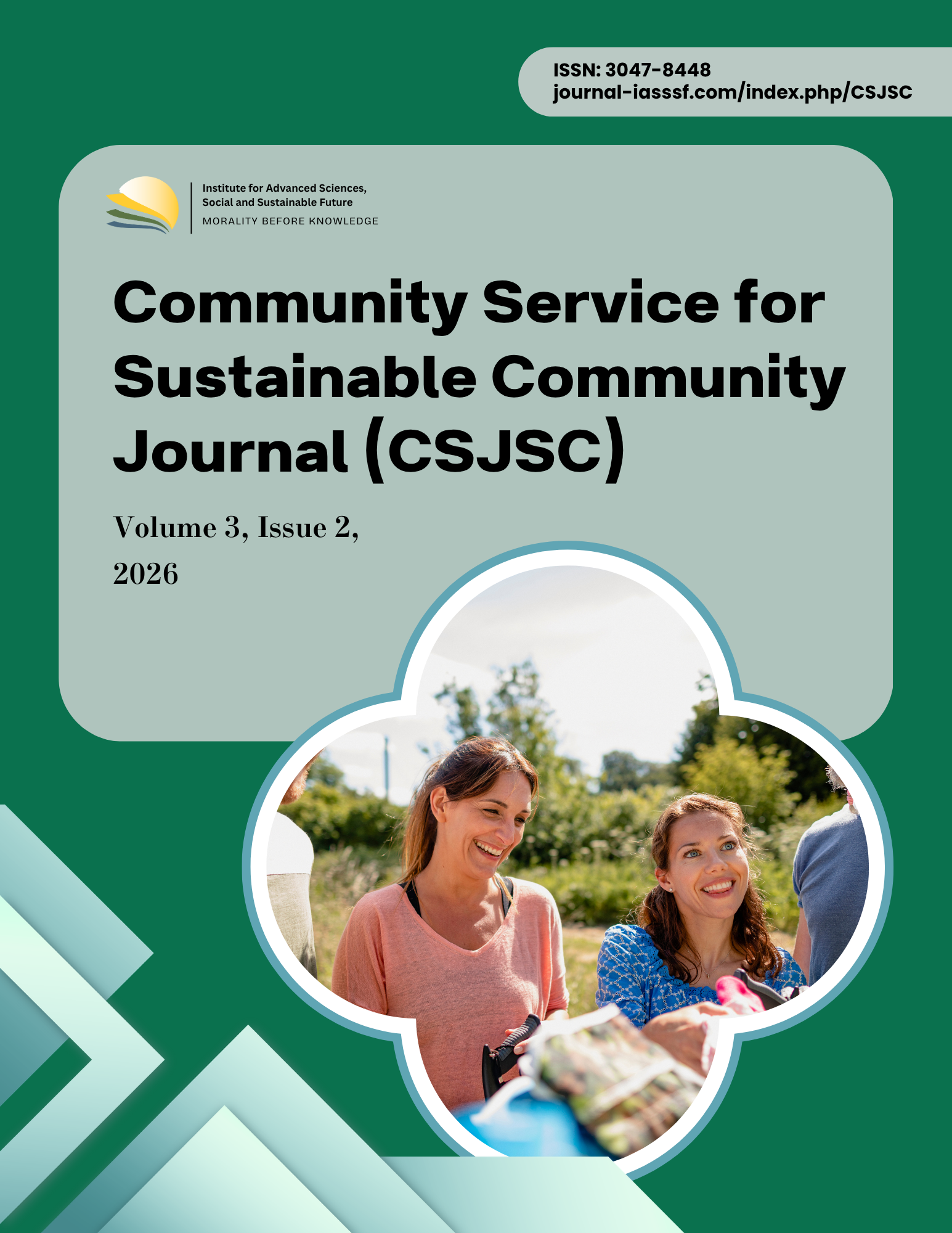
Multidisciplinary student synergy through the KKM program as an effort to improve the quality of health, education, and community environmental awareness
DOI:
https://doi.org/10.61511/csjsc.v3i2.2026.3452Keywords:
community service, environment, multidisciplinary, public health, student work lecturesAbstract
Background: Student community service program (Kuliah Kerja Mahasiswa, KKM) bridges universities with rural community needs in health, education, environmental management, and social development. Although participatory community service has been shown to improve public knowledge and behavior, evidence on integrated multidisciplinary KKM remains limited. This study analyzed the implementation of a multidisciplinary KKM program in Jayamekar Village from January to February 2026. Methods: A community-based participatory approach was implemented through free health screening, anti-bullying education, biopore training, pest and plant disease counseling, and road reflector installation, supported by school teaching, Qur'an teaching, handwashing campaigns, group exercise, educational competitions, and community events. Data were collected through participatory observation and activity documentation and analyzed descriptively. Findings: 38 residents participated in free health screening and demonstrated increased awareness of early disease detection and healthy lifestyles. More than 70 children showed improved learning motivation, literacy engagement, and understanding of positive social behavior. Environmental activities strengthened community knowledge of organic waste management, while road reflector installation enhanced perceived road safety. The integrated implementation also promoted active community participation and collaboration between university students and local residents. Conclusion: The multidisciplinary KKM program contributed to community empowerment by addressing interconnected health, education, environmental, and social issues through participatory engagement. However, the findings are limited by the descriptive design, single-village setting, and absence of quantitative outcome measures. Novelty/Originality of this article: This study provides empirical evidence on an integrated multidisciplinary KKM model that coordinates health, education, environmental, safety, and social empowerment initiatives within a participatory village-based community service program.
References
Afandi, A., Laily, N., Wahyudi, N., Umam, M. H., Kambau, R. A., Rahman, S. A., Sudirman, M., Jamilah, Kadir, N. A., Junaid, S., Nur, S., Parmitasari, R. D. A., Nurdiyanah, Wahyudi, J., & Wahid, M. (2022). Metodologi pengabdian masyarakat. Direktorat Pendidikan Tinggi Keagamaan Islam.
Aláez, M., Díaz-Iso, A., Eizaguirre, A., & García-Feijoo, M. (2022). Bridging generation gaps through service-learning in higher education: a systematic review. Frontiers in Education, 7, 841482. https://doi.org/10.3389/feduc.2022.841482
Álvarez-Vanegas, A., Ramani, S. V., & Volante, L. (2024). Service-learning as a niche innovation in higher education for sustainability. Frontiers in Education, 9, 1291669. https://doi.org/10.3389/feduc.2024.1291669
Argarani, D., Yusuf, R. Z., & Malik, A. (2025). Pemberdayaan masyarakat sebagai penentu pembangunan berkelanjutan di pedesaan. Jurnal Pemberdayaan Ekonomi dan Masyarakat, 2(4), 11. https://doi.org/10.47134/jpem.v2i4.943
Batubara, S. O., Wang, H. H., & Chou, F. H. (2020). Literasi kesehatan: Suatu konsep analisis. Jurnal Keperawatan Muhammadiyah, 5(2). https://doi.org/10.30651/jkm.v5i2.5683
Boston, M., Bernie, D., Brogden, L., Forster, A., Galbrun, L., Hepburn, L.-A., Lawanson, T., & Morkel, J. (2024). Community resilience: A multidisciplinary exploration for inclusive strategies and scalable solutions. Resilient Cities and Structures, 3(1), 114–130. https://doi.org/10.1016/j.rcns.2024.03.005
Clark, E. C., Baidoobonso, S., Phillips, K. A. M., Noonan, L. L., Bakker, J., Burnett, T., Stoby, K., & Dobbins, M. (2024). Mobilizing community-driven health promotion through community granting programs: A rapid systematic review. BMC Public Health, 24(1), 932. https://doi.org/10.1186/s12889-024-18443-8
Culcasi, I., & Venegas, R. P. F. (2023). Service-learning and soft skills in higher education: A systematic literature review. Form@re - Open Journal per La Formazione in Rete, 23(2), 24–43. https://doi.org/10.36253/form-14639
Djazuli, R. A. (2024). Evaluasi Program Pemberdayaan Masyarakat. UMG Press.
Gray, C., Porter, G., Lobo, R., & Crawford, G. (2024). Development and evaluation of health education resources for culturally and linguistically diverse populations: A systematic review. Health Education Research, 39(2), 102–118. https://doi.org/10.1093/her/cyad015
Han, G., & Niles, M. T. (2023). An adoption spectrum for sustainable agriculture practices: A new framework applied to cover crop adoption. Agricultural Systems, 212, 103771. https://doi.org/10.1016/j.agsy.2023.103771
Haryani, D. (2024). The role of hygiene education in forming healthy living habits in children. Research of Service Administration Health and Sains Healthys, 5(1). https://doi.org/10.58258/rehat.v5i1.7318
Hsu, C.-H. (2025). Outdoor environmental education as a nature-based solution for “education” and “environment”: A new conceptual framework and its pilot application in a coastal community case study in Taiwan. Journal of Coastal Conservation, 29(1), 13. https://doi.org/10.1007/s11852-025-01099-w
Huang, J., Gong, F., Chen, Z., Chen, Y., & Liu, Y. (2025). Application and effectiveness of experiential education combined with health coaching techniques in extended care for elderly patients with dental implants. Frontiers in Oral Health, 6, 1538886. https://doi.org/10.3389/froh.2025.1538886
Hulse, A. L. (2022). A multidisciplinary learning approach: A narrative review. British Journal of Nursing, 31(7), 364–370. https://doi.org/10.12968/bjon.2022.31.7.364
İNci̇, S., & Kaya, V. H. (2022). EĞİTİMDE MULTİDİSİPLİNER, DİSİPLİNLERARASI VE TRANSDİSİPLİNER KAVRAMLARI. Milli Eğitim Dergisi, 51(235), 2757–2772. https://doi.org/10.37669/milliegitim.905241
Kanu, I. M., Sule, P. C., Chukwurah, U. A., & Murtala, A. (2024). Enhancing health outcomes through community-based health education programs for underserved populations. World Journal of Advanced Research and Reviews, 24(3), 3260–3283. https://doi.org/10.30574/wjarr.2024.24.3.3928
Kerimbayev, N., Umirzakova, Z., Shadiev, R., & Jotsov, V. (2023). A student-centered approach using modern technologies in distance learning: A systematic review of the literature. Smart Learning Environments, 10(1), 61. https://doi.org/10.1186/s40561-023-00280-8
Li, M., Xie, H., & Shu, P. (2021). Study on the impact of traffic accidents in key areas of rural roads. Sustainability, 13(14), 7802. https://doi.org/10.3390/su13147802
Lin, J. C., & Shih, Y.-H. (2024). Strategies for preventing school bullying—A life education perspective. Frontiers in Psychology, 15, 1429215. https://doi.org/10.3389/fpsyg.2024.1429215
Lin, S., Ngai, G., Kwan, K. P., Chan, S. C. F., & Lo, K. W. K. (2025). Mandatory academic service learning and continual civic engagement: which learning outcomes matter? The Asia-Pacific Education Researcher, 34(3), 965–974. https://doi.org/10.1007/s40299-024-00911-9
Martini, D., Ragone, G., Cazzini, F., Cheli, F., Formici, G., La Porta, C. A. M., Pinotti, L., Pomodoro, L., Restani, P., Scaffardi, L., Tedeschi, G., Riso, P., & Violini, L. (2021). The need for a multidisciplinary approach to face challenges related to food, health, and sustainability: The contribution of CRC I-WE. Sustainability, 13(24), 13720. https://doi.org/10.3390/su132413720
Matinho, D., Pietrandrea, M., Echeverria, C., Helderman, R., Masters, M., Regan, D., Shu, S., Moreno, R., & McHugh, D. (2022). A systematic review of integrated learning definitions, frameworks, and practices in recent health professions education literature. Education Sciences, 12(3), 165. https://doi.org/10.3390/educsci12030165
Nanda, S. B., Satapathy, D., Panda, G., & Pradhan, D. K. (2025). Socio-emotional learning and competencies in 21st-century education: A systematic review of teacher and student perspectives. Discover Education, 4(1), 338. https://doi.org/10.1007/s44217-025-00796-w
Ningrum, I. H., Tohani, E., & Sugito. (2025). Environmental education strategies for supporting sustainable waste management: A systematic literature review. Jurnal Penelitian Pendidikan IPA, 11(10), 133–142. https://doi.org/10.29303/jppipa.v11i10.10550
Organisation for Economic Co-operation and Development. (2021). Beyond academic learning: first results from the survey of social and emotional skills 2019. OECD. https://doi.org/10.1787/92a11084-en
Pandawa, H., Achmad, M., Nurdin, I., & Sartika, I. (2025). Community participation of community-based development in Malinau Regency North Kalimantan Province. International Journal of Social Service and Research, 5(7), 818–833. https://doi.org/10.46799/ijssr.v5i7.1270
Qorib, F. (2024). Tantangan dan peluang kolaborasi antara perguruan tinggi dan masyarakat dalam program pengabdian di indonesia. Journal of Indonesian Society Empowerment, 2(2), 46–57. https://doi.org/10.61105/jise.v2i2.119
Rodríguez-Zurita, D., Jaya-Montalvo, M., Moreira-Arboleda, J., Raya-Diez, E., & Carrión-Mero, P. (2025). Sustainable development through service learning and community engagement in higher education: A systematic literature review. International Journal of Sustainability in Higher Education, 26(1), 158–201. https://doi.org/10.1108/IJSHE-10-2023-0461
Singh, H., Fulton, J., Mirzazada, S., Saragosa, M., Uleryk, E. M., & Nelson, M. L. A. (2023). Community-based culturally tailored education programs for black communities with cardiovascular disease, diabetes, hypertension, and stroke: Systematic review findings. Journal of Racial and Ethnic Health Disparities, 10(6), 2986–3006. https://doi.org/10.1007/s40615-022-01474-5
Stover, J., Avadhanula, L., & Sood, S. (2024). A review of strategies and levels of community engagement in strengths-based and needs-based health communication interventions. Frontiers in Public Health, 12, 1231827. https://doi.org/10.3389/fpubh.2024.1231827
Syafri, F., Nursasongko, R., Kristiawan, M., Kusuma, W. H., Meta, O. A., & Vasudevan, H. (2025). Value-based education of religious moderation for children in schools and families. International Journal of Learning Reformation in Elementary Education, 4(03), 284–298. https://doi.org/10.56741/ijlree.v4i03.1215
Uwase, M. (2025). The impact of community service on student engagement. Research Invention Journal Of Current Research In Humanities And Social Sciences, 4(1), 18–23. https://doi.org/10.59298/RIJCRHSS/2025/411823
Wang, Q.-C., Liu, X., Jian, I. Y., Zhang, E.-J., Hou, Y.-T., Siu, K. W. M., & Li, Y.-B. (2023). Community resilience in city emergency: Exploring the roles of environmental perception, social justice and community attachment in subjective well-being of vulnerable residents. Sustainable Cities and Society, 97, 104745. https://doi.org/10.1016/j.scs.2023.104745
Westerbeek, H., & Eime, R. (2021). The physical activity and sport participation framework—A policy model toward being physically active across the lifespan. Frontiers in Sports and Active Living, 3, 608593. https://doi.org/10.3389/fspor.2021.608593
World Health Organization. (2020a). Community engagement: A health promotion guide for universal health coverage in the hands of the people (1st ed). World Health Organization.
World Health Organization. (2020b). Health promotion and disease prevention through population-based interventions. WHO. https://www.who.int
Downloads
Published
Issue
Section
Citation Check
License
Copyright (c) 2026 Asep, Laila Munawaroh

This work is licensed under a Creative Commons Attribution 4.0 International License.